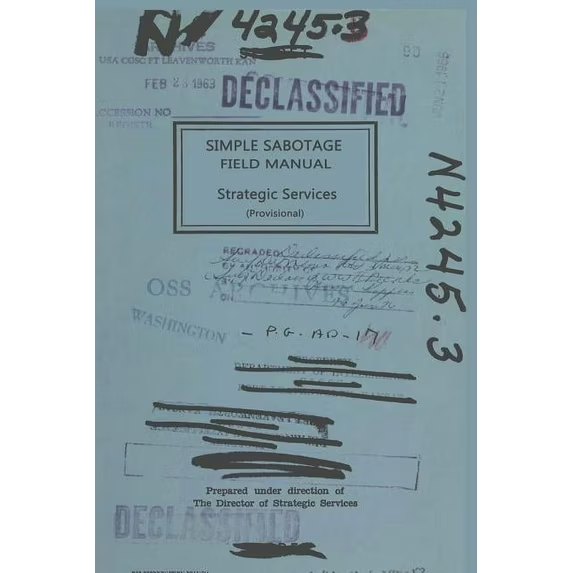
Simple Sabotage or Not?

This image is a vivid example of a declassified document.

The context or discovery of this document was from a discussion on how in a family, in an organization, or even in a larger context, there are subtle and not so subtle ways of disruption. The disruptive activities can be bilateral: from workers in a company and from management of the company for example. The booklet was intended for operatives working behind enemy lines in World War II. It is from the precursor of the Central Intelligence Agency (CIA) known as the Office of Strategic Services (OSS). It was written in 1944 and signed off by William Donovan.

The Introduction states the purpose of the paper, ‘to characterize simple sabotage, to outline its possible effects, ….. ‘.

The specific suggestions are listed in a variety of categories, buildings, water/miscellaneous, Industrial production including manufacturing, metals, mining, agriculture, transportation, communications, electric power, and organizations. The ‘organizations’ section contains many behaviors that are commonplace and performed at all levels.

The following are the last entries.

11. General Interference with Organizations and Production

(a) Organizations and Conferences

(1) Insist on doing everything through “channels.” Never permit short-cuts to be taken in order to expedite decisions.

(2) Make “speeches.” Talk as frequently as possible and at great length. Illustrate your “points” by long anecdotes and accounts of personal experiences. Never hesitate to make a few appropriate “patriotic” comments.

(3) When possible, refer all matters to committees, for “further study and consideration.” Attempt to make the committees as large as possible—never less than five.

(4) Bring up irrelevant issues as frequently as possible.

(5) Haggle over precise wordings of communications, minutes, resolutions.

(6) Refer back to matters decided upon at the last meeting and attempt to re-open the question of the advisability of that decision.

(7) Advocate “caution.” Be “reasonable” and urge your fellow-conferees to be “reasonable” and avoid haste which might result in embarrassments or difficulties later on.

(😎 Be worried about the propriety of any decision—raise the question of whether such action as is contemplated lies within the jurisdiction of the group or whether it might conflict with the policy of some higher echelon.

(b) Managers and Supervisors

(1) Demand written orders.

(2) “Misunderstand” orders. Ask endless questions or engage in long correspondence about such orders. Quibble over them when you can.

(3) Do everything possible to delay the delivery of orders. Even though parts of an order may be ready beforehand, don’t deliver it until it is completely ready.

(4) Don’t order new working materials until your current stocks have been virtually exhausted, so that the slightest delay in filling your order will mean a shutdown.

(5) Order high-quality materials which are hard to get. If you don’t get them argue about it. Warn that inferior materials will mean inferior work.

(6) In making work assignments, always sign out the unimportant jobs first. See that the important jobs are assigned to inefficient workers of poor machines.

(7) Insist on perfect work in relatively unimportant products; send back for refinishing those which have the least flaw. Approve other defective parts whose flaws are not visible to the naked eye.

(😎 Make mistakes in routing so that parts and materials will be sent to the wrong place in the plant.

(9) When training new workers, give incomplete or misleading instructions.

(10) To lower morale and with it, production, be pleasant to inefficient workers; give them undeserved promotions. Discriminate against efficient workers; complain unjustly about their work.

(11) Hold conferences when there is more critical work to be done.

(12) Multiply paper work in plausible ways. Start duplicate files.

(13) Multiply the procedures and clearances involved in issuing instructions, pay checks, and so on. See that three people have to approve everything where one would do.

(14) Apply all regulations to the last letter.

(c) Office Workers

(1) Make mistakes in quantities of material when you are copying orders. Confuse similar names. Use wrong addresses.

(2) Prolong correspondence with government bureaus.

(3) Misfile essential documents.

(4) In making carbon copies, make one too few, so that an extra copying job will have to be done.

(5) Tell important callers the boss is busy or talking on another telephone.

(6) Hold up mail until the next collection.

(7) Spread disturbing rumors that sound like inside dope.

(d) Employees

(1) Work slowly. Think out ways to increase the number of movements necessary on your job: use a light hammer instead of a heavy one, try to make a small wrench do when a big one is necessary, use little force where considerable force is needed, and so on.

(2) Contrive as many interruptions to your work as you can: when changing the material on which you are working, as you would on a lathe or punch, take needless time to do it. If you are cutting, shaping or doing other measured work, measure dimensions twice as often as you need to. When you go to the lavatory, spend a longer time there than is necessary. Forget tools so that you will have to go back after them.

(3) Even if you understand the language, pretend not to understand instructions in a foreign tongue.

(4) Pretend that instructions are hard to understand, and ask to have them repeated more than once. Or pretend that you are particularly anxious to do your work, and pester the foreman with unnecessary questions.

(5) Do your work poorly and blame it on bad tools, machinery, or equipment. Complain that these things are preventing you from doing your job right.

(6) Never pass on your skill and experience to a new or less skillful worker.

(7) Snarl up administration in every possible way. Fill out forms illegibly so that they will have to be done over; make mistakes or omit requested information in forms.

(😎 If possible, join or help organize a group for presenting employee problems to the management. See that the procedures adopted are as inconvenient as possible for the management, involving the presence of a large number of employees at each presentation, entailing more than one meeting for each grievance, bringing up problems which are largely imaginary, and so on.

(9) Misroute materials.

(10) Mix good parts with unusable scrap and rejected parts.

(12) General Devices for Lowering Morale and Creating Confusion

(a) Give lengthy and incomprehensible explanations when questioned.

(b) Report imaginary spies or danger to the Gestapo or police.

(c) Act stupid.

(d) Be as irritable and quarrelsome as possible without getting yourself into trouble.

(e) Misunderstand all sorts of regulations concerning such matters as rationing, transportation, traffic regulations.

(f) Complain against ersatz* materials.

(g) In public treat axis nationals or quislings** coldly.

(h) Stop all conversation when axis nationals or quislings enter a cafe.

(i) Cry and sob hysterically at every occasion, especially when confronted by government clerks.

(j) Boycott all movies, entertainments, concerts, newspapers which are in any way connected with the quisling authorities.

(k) Do not cooperate in salvage schemes.

Perhaps your perspective will change when you see these things happening. Benign actions or sabotage be it overt or subtle?

The text can be downloaded from Project Guttenberg

https://www.gutenberg.org/…/epub/26184/pg26184-images.html

*ersatz – made or used as a substitute usually an inferior one.

**collaborator or traitor

I found this amusing and at the same time concerning. My guess is that we have all seen and experienced some of these things without questioning the motivation behind it, if any.

The next time I observe one or more of these behaviors I will ask myself is this a purposeful disruption?

Polhamus – a family search

This is an odd way to gather information, but it may be worth a try. I have a project that was started by my great-grandfather, William Henry Harrison Polhamus. He wrote his memoirs of his time serving the Union during the Civil War. His stated desire was to have these pieces published, for his comrades in arms but also for his kin. That never happened. I have discovered those memoirs and I have just finished re-writing them word for word. I am continuing to edit so the contemporary reader can understand the context and I am verifying names and events as best possible. There are a number of instances where he talks about going back to visit people who he saved and those who saved him. He never fulfilled that goal as well. My work is cut out for me.

This is the Polhamus line that I need help from

  • Father – Albert Polhamus 1809-1875
  • Mother – Lucy E A Delano Polhamus 1815-1885
  • Siblings
    • John C. Polhamus 1858-
    • Heny M. Polhamus 1854-
    • Hannah M. Polhamus 1852-
    • Phillip T. Polhamus 1847-1930
    • Albert H. Polhamus 1837-1899
    • Cordellia A. Polhamus 1832-1900
    • Lucy Marion Polhamus
    • Helen Marr Polhamus

Nathan served in the Ohio 7th Infantry Co G

Albert served in the New York 70th Infantry Co A

Phillip served in the Michigan 23rd Infantry Co D

What I am looking for is information on the brothers; Nathan, Albert, and Phillip – The family had 4 who served in the war.

I am also looking for pictures that William had sketched with his memoirs. It would also be great to have contact information for my plan is to get this work published and circulated to his family as he wanted to do.

Thanks,

FEL 1/31/2024

Seeing your own gravemarker?

A number of years ago, a friend of mine called to make sure I was okay. This was a rather odd thing for him to do, so I asked what caused him to call? He stated that he was doing some work in a cemetery in Mooresville (?), Indiana and as he looked about he saw a gravestone with my name on it.

I assured him I was alright, but I needed to see what he was taking about. This is what he was seeing-

The last name is pronounced the same, however, the spelling is dramatically different. Leickly came from Leichli, which originally was Lauchli (that ‘a’ has an umlaut over it).

The eerie parts are the same first name and the year of death of Fred Likely was the year of birth for Fred Leickly.

FEL 1/31/2024

SCAMS- Bitdefender users beware

This is not a poke at Bitdefender- I have used them for years and I am very happy with their coverage and service. Vlad also was extremely helpful in verifying information, explaining safe company practices, guiding me through an installation when I was still very hot under the collar regarding a group of people who pride themselves in working only to take something from someone else. I was not sure where to post this, so it would make sense and hopefully keep someone from this experience.

So my computer was reset to factory conditions (the Dell people very helpful). I needed to populate the computer with programs. My data was gone, I had a blank page (or hard drive) to work on. My thought was that security was the first step. On to Bitdefender. I was unable to log on my account – the message was strange telling me that there was too much recent activity and I needed to call to get it figured out.

That call was made (from my cell phone – 860-924-3822. The fellow who answered said that a tech would call me shortly. He call again telling me that a call was placed and I did not answer it and I needed to answer to get the support. I had received no call, and he was too fast to verify my phone number. Moments later, Joseph calls. Oddly, he immediately identified himself as a Bitdefender employee, gave his name as Joseph Ryan badge number BIT77921 and phone # 404-300-3183.

Without any evaluation, I was told I had a Trojan virus on my network and he needed to access my computer to deal with it. He was evasive when asked how that happened with the protection programs onboard. Suspicions grew, he wanted my name, address, email address cell phone number, but when I countered with a few questions about my account he continued to evade the question. If my account was in front of him, he should have been aware of a few things that Bitdefender would know and he was not.

I sensed fraud and potential scam. I ended the call with a few words that are not worth repeating here. I got no return call – a legitimate representative would want a positive interaction.

I got in touch with Bitdefender- we both passed each other’s security questions. The program was uploaded and Vlad provided advice;

  1. If the ad for the support hits with a phone number immediately – be suspicious
  2. If the add has misspelled words and seems off – be suspicious
  3. BD does not have ID tags – this AH spammer tried to alleviate suspicion by given a fictitious number
  4. Calls – they asked to call me back – not a sop.

I hate these type of experiences – you work hard for what you have and someone feels that it theirs to try to get from you.

My advice – have some piece of information that the legit company has on your account and if the person on the other end of the line can’t tell you what that is, HANG UP

Golden Wedding Anniversary Story

Well Linda and I celebrated 50 years of marriage on June 30th, 2023. We had plans to be on the road to North Star Lake, Minnesota to see family so the ‘celebration’ had to be on June 29th. I made reservations for 7:00 pm at our favorite restaurant, Angotti’s. During the hours before it took four visits to florists to find a corsage for her. I took the corsage to Angotti’s and gave it to the owner/chef, Ingrid. She was to give it to Linda upon arrival and she should the bouquet of roses setting at our table. Sounds like a great plan, right?

Then Mother Nature intervened. A rather impressive storm knocked out the power in downtown Columbus at about 4:30. We arrived for our date at about 6:50- Angotti’s was closed, and the entire area was dark. Linda had no idea what I had planned. I insisted we wait for a while. By 7:15 I realized this was not going to happen. I told her what was planned, and we went to Amazing Joe’s for steak.

She was amused by the story. We enjoyed our meal and when it was time to square up (pay the bill), the server said we were good to go, someone had paid for our dinner. We will never know who did that, but THANK YOU- it was a nice ending for a day that did not live up to expectations.

While on the road to Minnesota, Angotti’s sent a picture of the corsage.

Now that day was supposed to also be a ribbon-cutting Columbus Chamber of Commerce event or grand opening for Angotti’s (the weather knocked that out too). Yesterday, the ribbon-cutting event took place. While partaking in the festivities Ingrid told us that corsage was still there and brought it out. There was availability for dinner there and we returned at 7:00. Chianti, Ceasar salad, fresh bread, lasagna, chicken parmesan, NY cheesecake, and limoncello were enjoyed along with the staff and ambiance of Angotti’s. Pictures were taken and are on Linda’s Facebook page.

It took a while, but our 50th anniversary was quite eventful.

FEL July 14, 2023

Fenugreek and Legume Sensitivity

The case of Fenugreek

Up until a week ago, I had never heard of fenugreek.  On my first day back at Riley to start the 2009 new year, I had a young man, just under 2 years of age who presented with concerns about reactions to legumes. The list of suspects included peas, green beans, black beans, baked beans, and lentils. The mother also shared with me that during breast feeding she used ‘fenugreek’. This product is used to help nursing mothers. In our discussion, the mother brought up the concern that the fenugreek may have contributed to the legume reactions.

I had not heard of ‘fenugreek’ prior to this. I have been involved with allergy long enough to know that any food product ingested by mankind for as long as we have been on the planet has been implicated in an allergic response. I wanted to know more about this ‘fenugreek’.

I consulted my online food ‘Allergy Advisor’ regarding fenugreek and got a wealth of information to get me started. To my surprise later that week the Journal of Allergy and Clinical Immunology (JACI) had an article from a group in Norway regarding fenugreek.

Fenugreek (aka Greek hay, Greek fennel, Bird’s foot, Greek hay-seed) is a legume. It is used as a flavoring in many foods including curry, blends of spice, and even tea. As an herbal medication it has been touted as being helpful in initiating and maintaining milk production. There are references for its use in diabetes and hypertension. Importantly, it is a legume and many legumes share certain proteins and may be cross-reactive in some patients.

The purpose of the JACI article was to evaluate the allergenicity and antigenicity of the proteins in fenugreek. There were 29 patients in the study who had specific IgE antibodies to legumes, peanut, soy, pea, lupin, and fenugreek. These patients ranged from 1 to 53 years of age. High levels of antibody to both peanut and fenugreek were found in most patients and the sensitization to fenugreek was believed to be due to cross-reactivity in those patients with peanut allergy. In this study, the reactivity to the other legumes was weaker. Here the other legumes (specifically peanut) were implicated in causing sensitization to fenugreek. With the young lad that I saw I wondered if there is the possibility that the fenugreek may have worked in the opposite direction – fenugreek exposure causing sensitization to the other legumes.

I was not aware of this association: fenugreek and peanut. In my clinic notes I debated about doing the peanut test since he had no exposure, but since he reacted to a large number of the other legumes I had the skin test placed. His response was positive to peanut.

The world of IgE-mediated reactions to foods is growing significantly. Our diets are changing with significantly more opportunities for ingredients in foods from other lands becoming part of our lives. Herbal supplements may contain a variety of items that could lead to sensitization. It is important to inquire about the use of such products.

The Sad Loss of the Patient History

This morning after finishing the Sunday paper, I browsed through one of my recent pediatric journals Contemporary Pediatrics Volume 26 . I was attracted to the ‘Your Voice’ article by Dr. Amar Dave of Ottawa, Ill titled above, the sad loss of the patient history. I applaud  Dr. Dave for the comments. The issue so adroitly pointed out the knack of physicians to depend on some sort of test especially when making a simple diagnosis.

The context is the always fascinating ‘Puzzler’ cases that are submitted by the readers. The case appeared in the September issue of the journal. The letter points out that the case is a “blatant example of what is happening to medical education”. The basic elements of our encounters with patients are the history of the illness and the physical examination. Dr. Dave points out that these skills are disappearing and are replaced by tests, radiographic studies, and more tests. Sometimes the tests are performed prior to taking a history and doing an examination. In this case, a thorough history and physical examination may have revealed the diagnosis. Tests sometimes beget more tests and this may not always be necessary and may be costly.

I see this way too often in the practice of allergy. Allergy tests are done prior to visiting with the physician, they are done as panels, and they are sometime performed in the operating room. Sometimes no relevant history is taken and the tests are used to make the diagnosis and treatment plan. In some situations this may work, however I have seen children who were denied foods that they enjoyed (and needed), families who were told to make drastic changes in their lives, animals that were sent elsewhere, and a significant amount of money spent not only for the test but also for special diets and gizmos to alter the environment. This  is not fair nor is it the proper way to do an allergy evaluation!

An allergist/clinical immunologist spends a significant amount of time deciding if the complaints fit a template or pattern of allergic disorders by taking that detailed history and doing an appropriate physical examination. The relevant allergens are then selected for testing. What is ‘relevant’? What I mean by relevant is that they are items that the child is exposed to and with that exposure there will be a reliable set of symptoms. Cause and effect relationships need to be established. For example, if milk is taken everyday and with the drinking of milk there are no symptoms of allergy, then the test should not have been done (given this history) and if the results were positive, then they are irrelevant. The value of the test results is only as good as the story or history that supports it.

Remember, the tests make no child allergic. The test only means that antibody is made or has been made. The allergic child has a set of symptoms consistent with allergy with positive tests to relevant allergens. I go more into this topic in the What is Allergy and Testing pages on this site.

Thank you Dr. Dave for lamenting the possibility of lose of an important part of medical training.

Seeking the best care for allergy

Every now and then I will bring in what I call ‘pet peeves’. These are for me everyday experiences that I have developed a humble opinion about and when the mood strikes I will elaborate on my perspective (properly plugged as pet peeve perspectives, perhaps?). So here goes – Pet Peeve Number 1- where to go for allergy care?

There are a number of health care specialists who offer allergy evaluations and allergy directed care. I have seen over the past week three new children who have had evaluations for allergy by someone who offers ‘allergy’ care and they were not allergists. In one instance a type of allergy test was done in the operating room. In one child, intradermal tests for foods were done ( a technique that is replete with false positive results) and most concerning was one child who was tested for foods, found to have a few positive responses, and was given a set of instructions that may have caused a problem. As I reviewed the previous allergy test records with the family I noted that the instructions were “3 days of total avoidance followed by 1 day of exposure to as much as could be eaten of the positive food”.

In the world of IgE-mediated, type-one hypersensitivity food ‘allergy’ reactions (see pages on What is an Allergy and Allergy Tests) the current recommendation is full and strict avoidance of the offending food. There is an evolving science that is helping with prevention and with treatment of some food allergies, but we are not there just yet. I have never come across a program that involves days of avoidance followed by overindulgence, nor could I find anything in the literature regarding this. This could be a very dangerous recommendation especially for a child who may have a systemic response such as hives or allergic shock.

The presenting problem was recurrent ear infections. Now here is where philosophies come into play. The track record even in the best designed study is that at a maximum 1/3 of children with recurrent ear infections may have allergy as a contributor. Between the lines, the allergens were inhalants and the 1/3 of children affected was the one study with the highest fraction. Many of the studies on this connection had fewer children triggered by allergy. In regards to foods, the reports from double-blinded placebo-controlled food challenges (this being the best way to prove a reaction) have shown that foods are a rare cause of isolated respiratory tract symptoms. What was also observed was the fact that if a food was involved, the families suspected it before the evaluation. Again the answer was in the medical history.

Who offers allergy care- well anyone can offer and perform some type of test for allergy. Therein lies the problem. Be ware of what and who is out there. Get the best for your investment of time, money, and safety. The American Academy of Allergy, Asthma, and Immunology (AAAAI) has a issued a position statement about questionable tests and testing procedures for allergy.  The bottom line on these evaluations is that it is not money well spent!

We have primary caretakers, allergists, and otolaryngologists (ENT) tauting expertise in allergy.

Let me describe an allergist- This is an individual who has primary training in either pediatrics or internal medicine. The individual then has done a 2-3 year training program in allergy/immunology and is then eligible to sit for their specialty boards. Allergy/Clinical Immunology is a conjoint board, one of the few that credentials trained individuals to see both children and adults within the context of their specialty. The graduate of the fellowship training program has the opportunity to sit for their specialty boards and they become a board certified allergist-clinical immunologist. They could then join one of two national groups that help set the standards of allergy care, the American College of Allergy, Asthma, and Immunology (ACAAI) and the American Academy of Allergy, Asthma, and Immunology (AAAAI). Through a tenure of membership in these organizations and in their primary specialty, the allergist may become for example a fellow of the American Academy of Pediatrics (AAP) and a fellow of the AAAAI.

Resolves for my pet peeve number 1.

1. Ask about credentials- What is the primary specialty- pediatrics, internal medicine, family practice, or ent surgery?

2. Where was the allergy training – a fellowship, part of surgical training, a course?

3. Is the practitioner boarded in the specialty of allergy? Are they board eligible in the specialty of allergy?

4. Are they a member of a peer group- ACAAI or AAAAI?

5. This one is very biased- although the allergist/immunologist has training in each world I would suggest the pediatric-trained allergist for the children. From my experience at a wonderful children’s hospital- you just have to know about kids and be kid-oriented to be more effective in what we do.

FEL

Too young to test for allergies?

How about this as pet peeve #2 in my allergy practice? I will share my thoughts and practice guidelines regarding the old adage is “the child too young to test for allergy”. I have heard this countless times from concerned parents. There may be some truth to this, but it depends on the situation. Oh, by the way this pertains to any type of allergy test. Let me elaborate.

First off, allergy takes time to develop. There has to be exposure to cause sensitization. Sensitization involves stimulating the immune system to make that allergy antibody called IgE. That antibody then circulates through the body and binds to cells in the gut, skin, respiratory tract, and cardiovascular system. So we need time, a genetically prone child (thank you mom and dad only please), and exposure.

Secondly the nature of the allergen is important to consider. We get a daily dose of food so food allergy has a chance of developing early in life. Inhalants such as animal dander, insect parts, mold spores, and pollen take longer. We then also need to consider the allergen of concern.

We can see food reactions beginning about 2-3 months of age and usually presenting as a form of eczema (dry, itchy, scaly skin) called ‘atopic dermatitis’. In our pediatric allergy clinic at Riley we can and do test infants with eczema looking to see if a food is a possible stimulant for the condition. We skin prick test for egg white, milk, wheat, soy, peanut, and fish (these foods account for more than 90% of food allergy in children) and provide the family with the results of the skin tests (they take only 15 minutes) and a game plan prior to leaving the office. Here the point is that food allergy can be seen in the very young and we can effectively test. So with the proper condition, that being a skin problem, allergy testing can be done and can be very helpful in the very young. Respiratory tract allergy however is a different story.

Respiratory tract illnesses- asthma, rhinitis, otitis media, and recurrent sinusitis can be due to inhalant allergy. Keep in mind that there are other things to also consider such as day care exposure, irritant responses, and possible structural problems.  Inhalants act differently. The first point to be made is that the child has to be God’s earth for at least one year before inhalant allergy can appear. Furthermore, it may take two but for the most part three outdoor seasons for the child to become sensitive to the pollens of trees, grasses, and weeds. This is obviously dependent upon where you live. In Florida, California, and Hawaii for example, the pollen season tends to be all year round. But here in Indiana the pollen seasons are limited to shorter durations. For indoor allergens such as insect parts, danders of dogs and cats. and mold, it takes at least a year for the exposure, sensitization, and symptom sequence to start. Testing an infant to inhalants/pollens would not reveal clinically relevant sensitivities.

So is the child too young to allergy test? I use these general guidelines-

  • Food allergy– early infancy and onward
  • Indoor inhalants– needs to be at least one year old to be of value
  • Pollens– usually three years old and beyond
  • Too young to test for allergy? Yes/No:  it truly depends upon what you are testing for.

FEL